
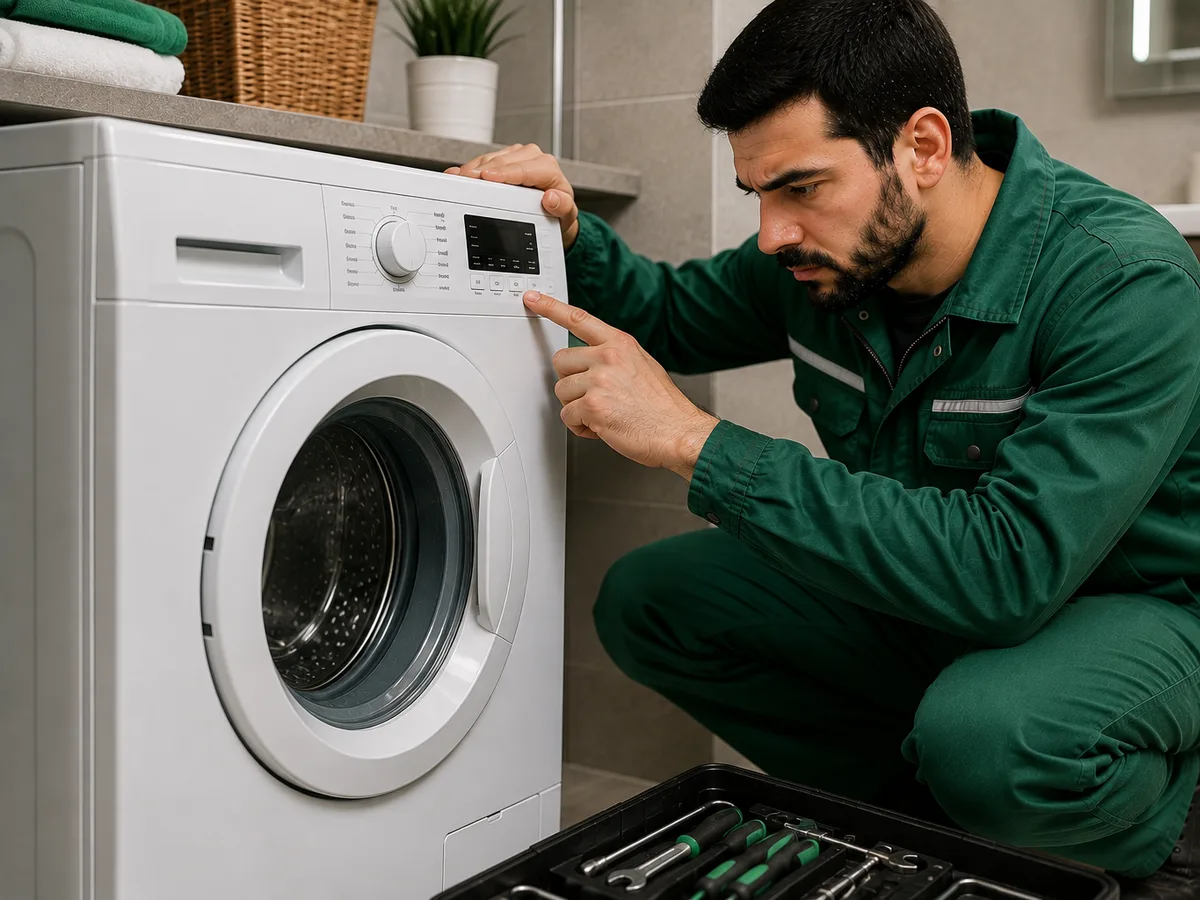
If the washing machine does not start, the cause may be related to various electrical, electronic, or mechanical faults. In some cases, the display does not turn on at all and the buttons do not respond, while in other cases the washing machine powers on, a program can be selected, but the washing cycle does not begin. The way the problem appears is important when determining the possible cause of the fault.
First, check whether the washing machine is receiving power. No electricity at the outlet, a tripped circuit breaker, an improperly connected plug, or a damaged power cable can prevent the appliance from turning on completely. If the display and indicator lights are completely off, the power supply is one of the first things that should be checked.
You should also inspect the condition of the power cable and plug. If the cable is crushed, melted, its insulation is damaged, or there are darkened or melted areas on the plug, using the appliance may be dangerous. In such a situation, disconnect the washing machine from the power supply and do not switch it on again until the problem has been resolved.
A faulty electrical outlet can also cause the washing machine not to turn on. Loose contacts, burnt connections, moisture, or a fault in the electrical line may prevent the appliance from receiving sufficient power. If the outlet becomes hot, is discolored, or smells burnt, it is advisable to have the electrical wiring checked by a specialist.
A door that is not fully closed is one of the most common reasons a washing machine program does not start. For safety reasons, most washing machines will not begin the washing cycle until the system receives confirmation that the door is properly closed. If the door does not close completely, the locking mechanism is jammed, or there is a problem with the door sensor, the appliance may detect the door as open.
If the door lock or locking mechanism is faulty, the washing machine display may turn on and a program may be selected, but the appliance may not start after pressing the Start button. Some models may also display a door-related error code. In this case, the door lock and its electrical connections should be checked.
A lack of water supply can also prevent the program from starting. If the water tap is closed, the inlet hose is bent, the inlet filter is blocked, or the household water pressure is too low, the washing machine may not be able to take in the required amount of water. Some models will not start the program if water is unavailable or may display an error shortly afterward.
A faulty water inlet valve should also be considered. This valve opens when it receives a signal from the electronic control system and allows water to enter the washing machine. If the electrical part of the valve is faulty, the mechanism is jammed, or the inlet is blocked, the machine may not fill with water and therefore may not begin the wash cycle.
If water remains inside the washing machine from the previous cycle, a drainage problem may also prevent a new program from starting. A blocked drain filter, a bent drain hose, or a faulty drain pump can make it difficult to remove the water. Some models may not fully begin a new program until the water from the previous cycle has been drained.
When the drain pump is faulty, the washing machine may try to start and produce a humming sound, but the program may not continue. A foreign object inside the pump, a jammed impeller, or a faulty pump motor can prevent normal drainage.
A faulty Start button can also prevent the washing machine from operating. The button contacts may wear out over time, or an electrical fault may develop in the control panel. If there is no response after pressing the button, the button and control panel should be inspected.
On washing machines with touch controls, certain areas of the panel may stop responding. Moisture, poor electrical contact, an electronic fault, or failure of the touch panel itself can make it impossible to select a program or start the appliance.
An activated child lock or control lock can also make it appear that the washing machine is not responding to the buttons. In this case, the appliance itself may not be faulty. The method for disabling the lock varies by model, so the user manual should be checked.
If the delayed start function is active, the washing machine may not begin immediately after pressing the Start button. If the program is set to begin after a certain period, it may seem as though the appliance is not working. Therefore, it is useful to check the timer and delayed start settings.
A fault in the electronic control board is one of the more serious possible causes. The control board manages the door lock, water inlet valve, motor, pump, heating element, sensors, and program stages. Voltage fluctuations, moisture, and failures of electronic components can interfere with its operation.
If there is a problem with the electronic board, the washing machine may not turn on at all, may not respond to buttons, may fail to start the program, or may stop immediately after beginning. However, the same symptoms can also be caused by other faulty components, so a full diagnosis should be performed before replacing the control board.
A faulty mains filter can also cause the appliance to receive no power at all. This component is involved in supplying power from the electrical network to the washing machine’s electronic system. If it fails, the appliance may appear completely dead.
A break, overheating, or poor contact in the internal wiring can also cause the washing machine not to work. In particular, if there is a problem with the electrical connections between the door, motor, pump, and control board, some components may stop receiving power or control signals.
A motor fault can also prevent the program from operating normally in some cases. If the washing machine fills with water but the drum does not rotate, the problem may be related to the motor, carbon brushes, inverter module, drive belt, or other drive components. This should be distinguished from a situation where the appliance does not power on at all.
In older washing machines, worn motor carbon brushes can also prevent the motor from starting. When the brushes are excessively worn, they cannot provide the required electrical contact and the drum may stop rotating. In modern washing machines with inverter motors, the problem may instead be related to the motor module or electronic control system.
Mechanical blockage of the drum can also prevent normal program operation. If a foreign object is trapped between the drum and tub, the bearing is seriously damaged, or another mechanical fault develops, the motor may be unable to rotate the drum.
Overloading the washing machine can also prevent the program from starting or the drum from entering the spin stage in some models. If more laundry is loaded than the manufacturer allows, the load may become unbalanced and the appliance may limit operation for safety reasons. In this case, removing some of the laundry and trying again may help.
Uneven distribution of laundry inside the drum can also cause the machine to stop, especially during the spin cycle. A large blanket, bedspread, or heavy clothing may gather on one side, causing the washing machine to stop spinning to reduce vibration.
Sometimes the washing machine turns on, the display lights up, and a program can be selected, but nothing happens after pressing the Start button. In such a situation, the main components to check include the door lock, water inlet system, control panel, mains filter, and electronic control board.
If the washing machine stops immediately after the program starts, this should be treated differently from a complete failure to start. A water inlet problem, drainage fault, door lock issue, sensor fault, motor problem, or electronic control board error can cause the program to stop shortly after starting.
An error code on the display can help identify the possible cause of the problem. Different brands and models use different error codes related to the door lock, water supply, drainage system, motor, and electronics. The meaning of a specific code can usually be checked in the appliance’s user manual.
If the washing machine does not start, repeatedly unplugging and reconnecting it or performing multiple resets may not solve the problem. If there is an electrical or electronic fault, repeated attempts to restart the appliance can sometimes cause additional damage.
Pay attention to the following signs: if the washing machine display does not turn on at all, the power cable or plug is damaged, there is a burning smell, water is visible under the appliance, the circuit breaker trips, the door does not lock, or the program still does not start after several attempts, do not continue using the washing machine and disconnect it from the power supply.
If the washing machine does not start, it is recommended to contact a professional washing machine repair technician. The technician can diagnose the appliance and check the power cable, mains filter, door lock, water inlet valve, drain pump, Start button and control panel, motor, internal wiring, and electronic control board. Once the exact cause of the fault has been identified, you should be informed in advance about the required repair work and cost.